
For years, I’ve worked 40 hours a week. Like so many people, I got up, went to work, paid my bills, and looked forward to my days off.
But somewhere along the way, I started feeling like I was spending too much of my life working and not enough of it actually living.
At 60 years old, I knew I wanted to slow down. My plan was to hold out until 62, start collecting Social Security, and then reduce my work hours. That extra income would help make up for the smaller paychecks.
It seemed like a sensible plan.
But then something happened that made me question why I was waiting.
Why I Decided Not to Wait Until 62
My employer started cutting my hours, but I was still expected to show up five days a week.
I was bringing home less money, yet work was still taking up five days of my life.
And I started thinking: If I’m already working fewer hours, why can’t I work fewer days, too?
I only have about a year and a half until I turn 62. Time seems to be flying by faster than ever, and I started wondering whether I could make those next 18 months work on a smaller paycheck.
Not by quitting my job or making some huge, risky life change.
Just by taking one day of my week back.
Of course, I couldn’t simply ignore the money. I still have bills to pay.
So I started looking at my expenses to see what I could change.
My First Win: Saving $63 a Month on Car Insurance
I started with car insurance because it seemed like one of the easiest bills to tackle.
I didn’t have to change my lifestyle or give anything up. I just needed to spend some time comparing prices.
I was paying $160 a month for car insurance.
After shopping around, I found coverage for $97 a month.
That’s a savings of $63 every month, or $756 over a full year.
And here’s the surprising part: I even got a lower deductible!
I’ve since found another quote for $78 a month, but I haven’t switched because I still need to compare the coverage carefully. I don’t want to save a few dollars only to discover I’ve given up protection I need.
The lesson I took from this wasn’t that everyone should switch insurance companies.
It was that sometimes we keep paying the same bills simply because we’re used to paying them.
And it might be worth asking whether there’s a better option.
The Change That Made a Big Difference in My Electric Bill
Living in Florida, air conditioning isn’t exactly optional!
My electric bill had climbed to around $500, and I knew something needed to change.
I had been running two portable air conditioners, often with one running on high around the clock.
I decided to replace them with two window units.
The two new units cost me less than one of those $500 electric bills. I also plan to sell the portable units to recover some of what I spent.
Now, I’m not suggesting that everyone should run out and replace their air conditioners. That’s not the point of this story.
What surprised me was the difference I started seeing in my electricity usage.
According to my electric company’s app, I had been using around 74 kilowatt-hours per day. After the change, my daily usage dropped to around 15–22 kilowatt-hours.
My bills have already moved from approximately $500 to $473 and then $374.
Those bills don’t yet represent a full month using the new window units, so I’m waiting to see what the next complete billing cycle shows.
The weather has also been less extreme than it was in June and July, which matters when comparing air-conditioning costs.
But it’s still warm here, my house feels comfortable, and the daily usage numbers are encouraging.
I’ll share an update when I have a full month’s results.
What I hope other women take away from this isn’t that window air conditioners are the answer.
It’s that one change you hadn’t considered might make a meaningful difference in your own expenses.
Maybe it’s insurance. Maybe it’s groceries. Maybe it’s something else entirely.
The important thing is to start looking.
Bringing My Lunch to Work — Still a Work in Progress!
Another expense I’m working on is buying food at work.
Even with my employee discount, spending $5, $6, $7, or $8 on lunch adds up.
And frankly, I’m tired of eating that food every day anyway!
I’ve been trying to bring lunch from home, but I haven’t exactly mastered the routine yet.
One evening, I made chicken salad with pineapple and jalapeños so I’d have something good to take to work the next day.
The following morning, I packed everything I needed.
Everything, that is, except the chicken salad.
Yep. I left the most important part sitting in the refrigerator!
I ended up buying a burger at work and putting my pineapple and jalapeños on that instead. It was definitely different!
I’ve also had mornings when I overslept and didn’t have time to pack anything.
I’m thinking I need to start getting everything ready the night before.
But that’s part of this journey, too.
I’m not going to get every change right the first time. I just need to keep trying.
The Scariest Part Was Asking for Four Days
Once I started looking at ways to lower my expenses, I finally worked up the nerve to ask about changing my availability at work.
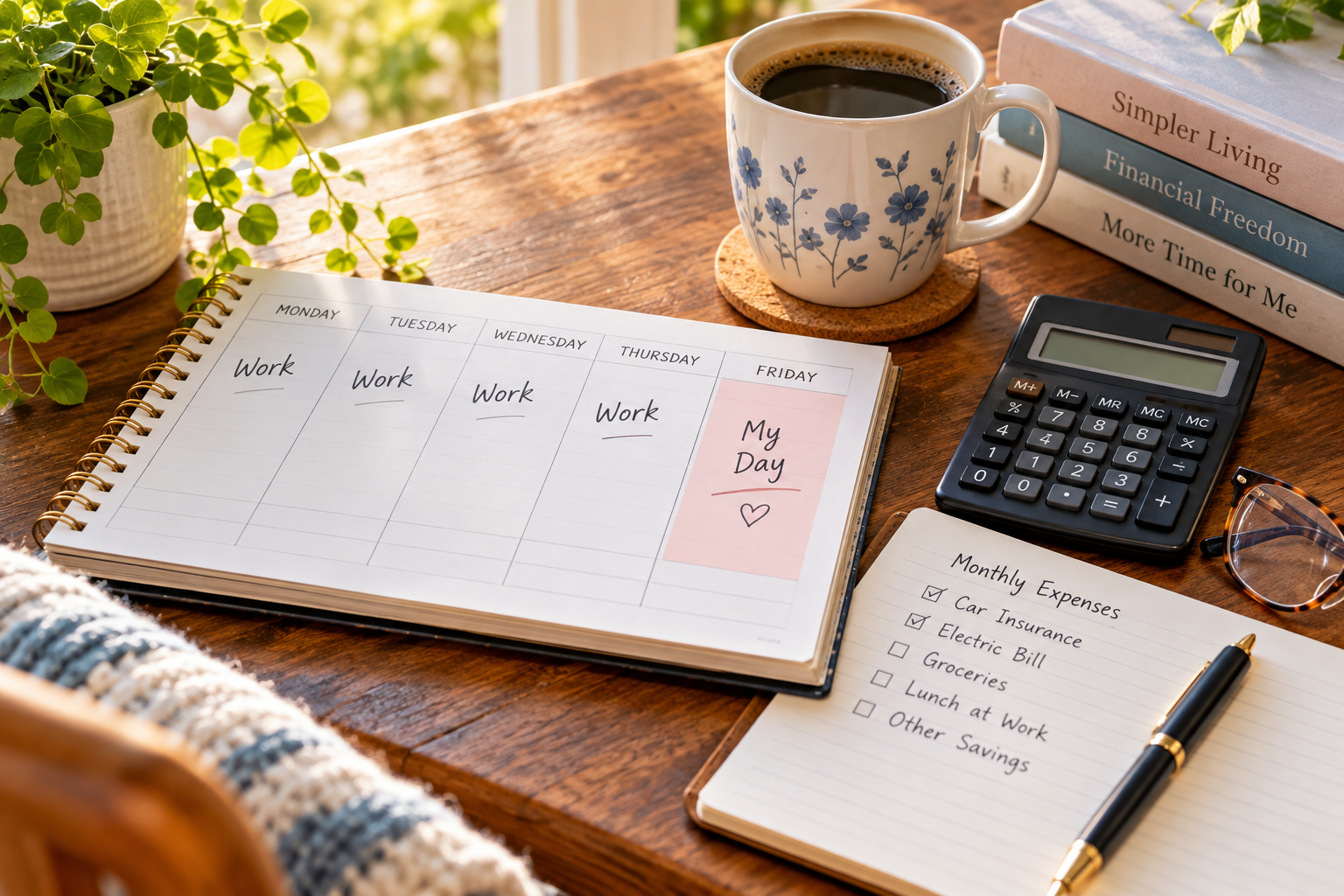
I wanted to work four days a week instead of five.
I was nervous.
My manager could have said no. But my bigger fear was that they’d say yes to four days and then schedule me for so few hours that I couldn’t afford it.
Our schedules are made weeks in advance, so even after my request was approved, I had to wait to see what my hours would actually look like.
When that first schedule came out, I was relieved.
Four days. Thirty-two scheduled hours.
It was what I’d been hoping for.
Now, I haven’t actually worked that first four-day week yet. I still have to see how the smaller paycheck feels and how everything works in real life.
And yes, I’m nervous.
After years of working 40 hours, dropping to 32 feels like a big step.
But I’m excited, too.
What I Really Want From That Extra Day
I’m not looking for a fancy retirement lifestyle.
I don’t need to travel every week or fill my calendar with activities.
I just want more time at home.
More time with my dog, Rocky. More time for my garden, my websites, and the little things I enjoy.
Right now, if I spend one of my days off doing something I love, I know the next day will be spent rushing around trying to get everything else done before I go back to work.
I want to be able to enjoy a day without feeling like I’m borrowing time from tomorrow.
That’s what working less means to me.
Not doing more.
Just having more room to breathe.
I’m Still Figuring This Out
I want to be clear about something: I haven’t proven that this plan will work perfectly.
I’m just getting started.
I still need to see what my paychecks look like, whether my expenses stay manageable, and how much more I can save.
But I’ve already learned something important.
Instead of only asking myself how I could make more money, I started asking how much money I actually need to earn.
Every expense I can reduce is a little less income I have to replace.
And every hour I don’t have to spend at work is an hour I get back for myself.
At 60 years old, that matters to me more than ever.
Maybe I’ll need to make more adjustments. Maybe I’ll pick up an occasional extra shift. Maybe some months will be tighter than others.
I’ll share the good, the bad, and probably a few more forgotten lunches along the way!
For now, I’m taking it one step at a time.
And I’m looking forward to seeing what life feels like with three days off each week.
Could You Afford to Work Less?
If you’ve been wishing you could cut back your work hours but aren’t sure whether you could afford it, I created a simple Freedom Calculator here on Senior Solo Living.
It lets you explore how changes in your expenses might affect your ability to work fewer hours or stretch your retirement income.
It won’t make the decision for you, but it can give you a starting point.
Try the Free Freedom Calculator
Because sometimes the first step toward having more freedom isn’t earning more money.
It’s taking a closer look at what you already spend.
And maybe, just maybe, finding a way to take a little of your time back.